The Grace
These pages only open the names the invocation already speaks. They are an approach to the prayer, not a second scripture.
அருட்பெருஞ்ஜோதி அருட்பெருஞ்ஜோதிதனிப்பெருங்கருணை அருட்பெருஞ்ஜோதி
Arut Perun Jothi, Arut Perun Jothi,Thani Perung Karunai, Arut Perun Jothi.
Eternal Grace Light, Eternal Grace LightSupreme Grace Compassion, Eternal Grace Light.
The mantra
Arut Perun Jothi
The invocation turns toward a light that already has a name. Arut Perun Jothi is the Eternal Grace Light. In the words kept on this site, it is the light Vallalar recognized as unbounded by doctrine, temple, or creed.
The line sung in his tradition is both greeting and remembrance. Arut Perun Jothi. Thani Perung Karunai — supreme, singular compassion. The mantra does not place a lamp on one side and kindness on the other. It says the light is the compassion, and the compassion is the light.
To repeat the line with attention is already the practice this offering is for.
Inner sight
The seven veils
The seeker asks for the opening of inner sight: to perceive the supreme reality behind all form, as Vallalar revealed the eternal light behind the seven veils of illusion.
At Vadalur the Sathya Gnana Sabai, the Hall of True Wisdom, was dedicated on 25 January 1872. It was raised for the worship of light. Seven screens stood between the one who entered and the flame, and they were drawn aside one by one. There is no formed idol at the center. The prayer reads those screens as veils. What is approached slowly is not hidden because it is private. It is approached so the eyes, and then the heart, can bear it.
The body of light
Deha Siddhi
The invocation addresses Vallalar as one who transformed the physical body into an immaculate body of light, and as one for whom death and dissolution are no longer a wall.
Devotees hold that on 30 January 1874, at Siddhi Valagam in Mettukuppam, he entered a room, the door was fastened, and when the room was opened the body was not there. The tradition receives this as union with the grace-light, spoken of as Deha Siddhi.
These pages do not try to prove that hour. They keep the prayer’s request in front of us: not extraordinary powers, and not the lower accomplishments of the mind, but the direct transmission of truth.
Universal compassion
Jeevakarunya
Jeevakarunya is compassion that does not stop at one’s own people. The invocation calls Vallalar its master, and remembers him weeping at the wilting of a single blade of grass.
That image sets the scale. If a blade of grass is enough to move the heart, then no living being stands outside the circle of care. The prayer asks to be taught how a dense nature becomes pure compassion, and how to serve all living beings with selfless love.
On 23 May 1867 he lit the stove of the Sathya Dharma Salai at Vadalur, a kitchen where a hungry person could eat without being asked their caste. The fire lit that day has been kept. In this path, a meal given without refusal is one way the light becomes visible.
Universal brotherhood
Samarasa Suddha Sanmarga
Samarasa Suddha Sanmarga is the name the prayer gives to the discipline of universal brotherhood. Samarasa — equal regard. Suddha — clean of the partitions we defend. Sanmarga — a true way of walking.
The seeker asks to be taught this, and to learn how the heart melts in devotion so that grace may pour in without measure. It is not offered here as a contest with other faiths. The same prayer says the light is not bounded by doctrine, temple, or creed.
The true teacher
Sathguru
The seeker asks Vallalar to stand before them as Sathguru, the True Guru, in his gentle form clad in white. The request is plain. Be my teacher, my guide, and my constant illumination. Guide my breath. Steady my intellect. Awaken the dormant light within my own heart center.
In this prayer a guru is not a person from whom powers are collected. The seeker has already refused that. The guru is the presence by which the light already abiding in the heart is recognized.
The hall
Vadalur
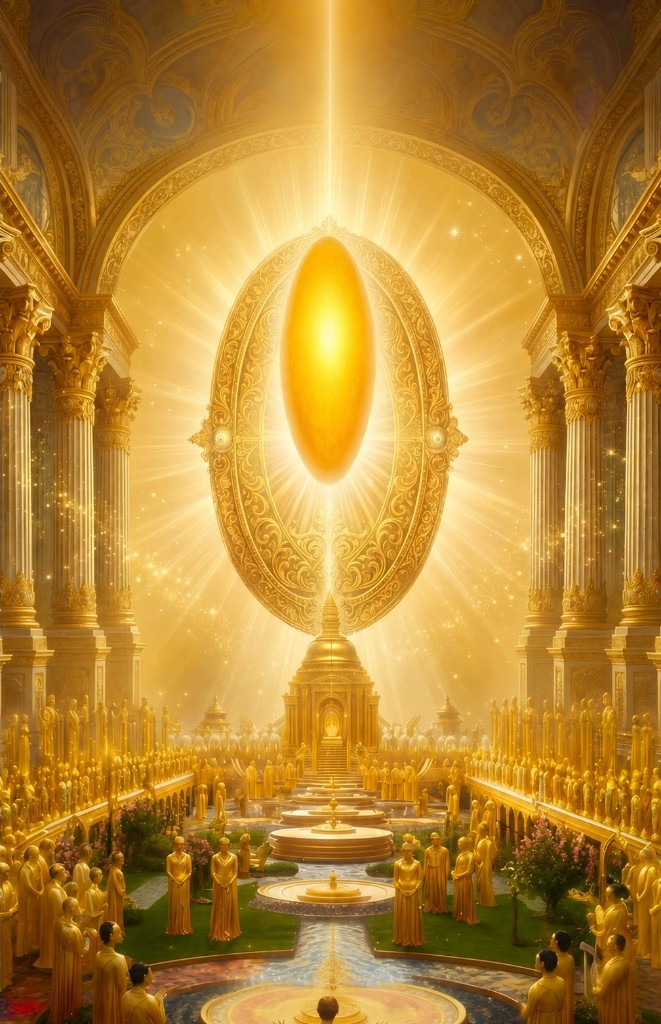
The invocation turns the mind toward Vadalur and the sacred hall of Sathya Gnana Sabai. People still go there. The golden hall behind these words is a devotional image of gathered light. It is not a photograph of the Sabai, and it is not a substitute for going, or for feeding someone who is hungry.
Ramalinga Swamigal — called Vallalar, the generous one, and Arutprakasa, the effulgence of grace — was born on 5 October 1823. The invocation on this site is dated 5 October 2026.
The prayer closes where it opened. Arut Perun Jothi. Thani Perung Karunai. Arut Perun Jothi.